Comstock Metals gives Indiana solar asset owners a certified path for end-of-life panels: R2v3-verified, zero-landfill, and fully traceable from pickup to final material recovery. The company’s facility in Cambridge, Ohio was built to serve a growing Midwest and eastern U.S. customer base, putting Indiana panels within a comparatively short haul of certified recycling as Comstock Metals’ national network continues to expand.
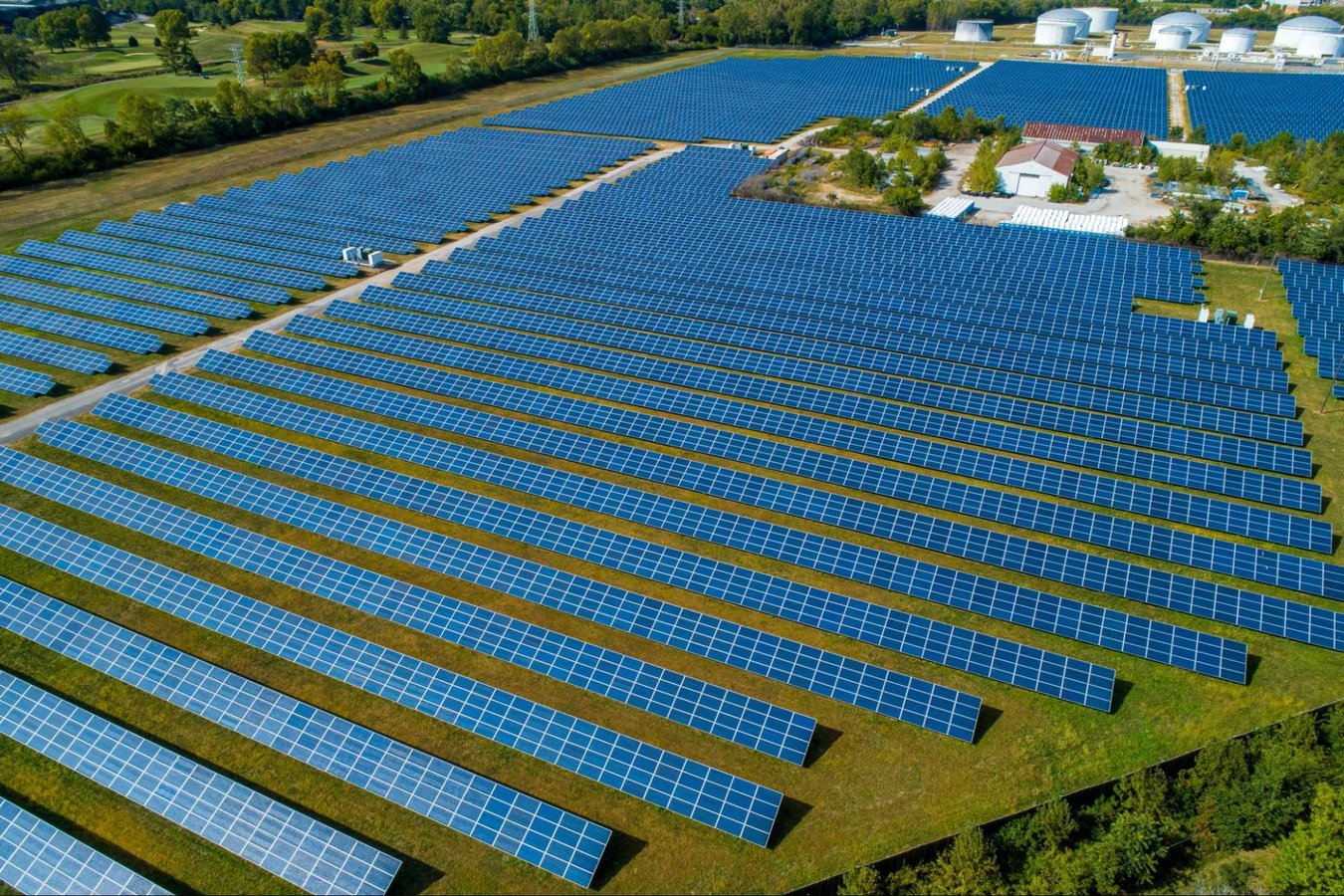
Indiana’s climate splits fairly cleanly along a north-south line. To the South, Evansville logs roughly 200 total days of sunshine a year while South Bend, close to Lake Michigan, sees closer to 170. Indianapolis sits in between at about 185. None of this variation has slowed the buildout: solar and storage projects keep landing on Indiana’s flat, open land as utilities and grid operators lean harder on the resource to meet rising regional demand.
Indiana’s installed solar capacity now tops 7,148 MWdc, placing it at 11th in the nation and 3rd for capacity added in 2025 alone, according to SEIA, which also projects that this will more than double to over 14,000 MW within five years, a top-five growth rate nationally.
This expansion is extending to the supply side, too. In July 2026, Canadian Solar subsidiary CS PowerTech opened a 6 GW heterojunction solar cell factory in Jeffersonville, the first facility of its kind built in the United States, with a second phase already planned.
Most solar panels retired from Indiana aren’t from a decommissioned system at all; they’re panels damaged during installation, rejected for manufacturing flaws, or worn down by ordinary wear over their service life.
Source: Solar in Indiana, SEIA
Indiana has not designated photovoltaic modules as universal waste. The state’s own universal waste list, batteries, agricultural pesticides, mercury-containing equipment, lamps, and aerosol cans, doesn’t include solar panels, so end-of-life modules fall instead under the same Resource Conservation and Recovery Act (RCRA) framework used for most other industrial waste in the state. The Indiana Department of Environmental Management (IDEM) administers that program under authority delegated by the U.S. EPA, with the state’s hazardous waste rules codified at 329 IAC 3.1 and largely mirroring the federal standards at 40 CFR Parts 260 through 270 and 273.
It falls to the generator, meaning the asset owner, to make the hazardous-or-not call, and Toxicity Characteristic Leaching Procedure (TCLP) testing for lead, cadmium, and similar constituents is usually how that call gets made. A panel that clears TCLP testing can be documented and handled as ordinary material; one that doesn’t get manifested and routed through a permitted hazardous waste facility instead. Two narrower federal carve-outs, the 2015 Verified Recycler Exclusion and the 2018 Transfer-Based Exclusion under 40 CFR 261.4, exist specifically to ease that burden when a legitimate recycler is on the receiving end.
No Indiana statute requires a decommissioning bond or reclamation plan for solar projects across the board, and that gap hasn’t gone unfilled. Because renewable energy siting in Indiana largely runs through county zoning boards rather than a state agency, individual counties have stepped in with their own rules, including LaPorte, Boone, and St. Joseph.
LaPorte County’s ordinance, for instance, requires developers to post a bond equal to the full estimated cost of removal, revisit that figure every five years, and finish decommissioning within a year once a project has sat idle for twelve months straight. Given how much this varies by jurisdiction, checking a county’s own ordinance is a better starting point than assuming a uniform state rule.
Nationally, the EPA still hasn’t ruled on whether to classify solar panels as universal waste across the board, a move that would simplify the movement of panels between states for recycling. Until that happens, a patchwork of state-by-state rules on both ends of any interstate shipment determines what’s allowed.
Our free tool lays out how those rules currently differ from state to state.
Comstock Metals brings that same certified process to Indiana asset owners, whatever the source: a farm-sited utility-scale array reaching end of life, damage discovered during installation, or defective cells coming off a production line before they’re ever deployed. Every panel is tracked from the moment it’s picked up through the moment its materials are recovered and processed at a Comstock Metals R2v3-certified site, with no landfilling and no offloading the problem onto an overseas buyer.
Comstock Metals provides full-service solar panel recycling for Indiana asset owners, including:
Keeping this process entirely in-house is what lets Comstock Metals hold Indiana projects to IDEM and RCRA standards without adding a layer of subcontractor risk, and it’s what keeps an owner’s liability from lingering long after the panels are gone.
Comstock Metals' Qualifications:

Contact Comstock Metals today to learn more about decommissioning and end-of-life solar panel management in Indiana.
Generally, yes. The crystalline silicon panels that dominate Indiana’s utility-scale and rooftop installs, along with thin-film modules, both break down cleanly at a qualified facility into glass, aluminum, silicon, and other recoverable material if processed correctly. Comstock Metals also accepts broken and damaged panels. Learn more about how we cleanly process these more difficult materials.
From decommissioning through transportation, paperwork that satisfies both the Indiana Department of Environmental Management (IDEM) and RCRA, and certified processing itself, Comstock Metals covers the full chain for Indiana utility-scale, commercial, and manufacturing-stage material alike. Learn more about our approach to compliance.
An accurate quote generally requires the project location, panel count and type, condition of the panels, expected timeline, and whether transportation or decommissioning support is needed. Reach out to us with any questions.
Not statewide, no, but you should check on a more local basis. Several Indiana counties, including LaPorte and Boone, have written their own bonding and removal requirements into local solar approvals, even though no single state law mandates one.
In contrast to states like California, there’s no PV-specific bucket in Indiana; retired panels get evaluated the same way any other potentially hazardous material would be, through IDEM’s standard TCLP-based determination process under its RCRA-delegated authority at 329 IAC 3.1.