End-of-life solar panels may be subject to different requirements depending on where they originated. Requirements can become more complex when Toxicity Characteristic Leaching Procedure (TCLP) test results are unavailable or when panels have not been tested and supporting documentation is incomplete.
This tool is designed to help you understand which regulations may apply and outline the documentation commonly associated with disposal, recycling, and transportation pathways.
Start by selecting your panel's state of origin from the dropdown, and we'll guide you through the next steps.
Disclaimer: This tool is intended as a general informational guide only and does not guarantee regulatory compliance or constitute legal advice. Additional considerations may apply depending on project-specific circumstances. If your situation falls outside the scenarios covered here, please contact our team for guidance.
|
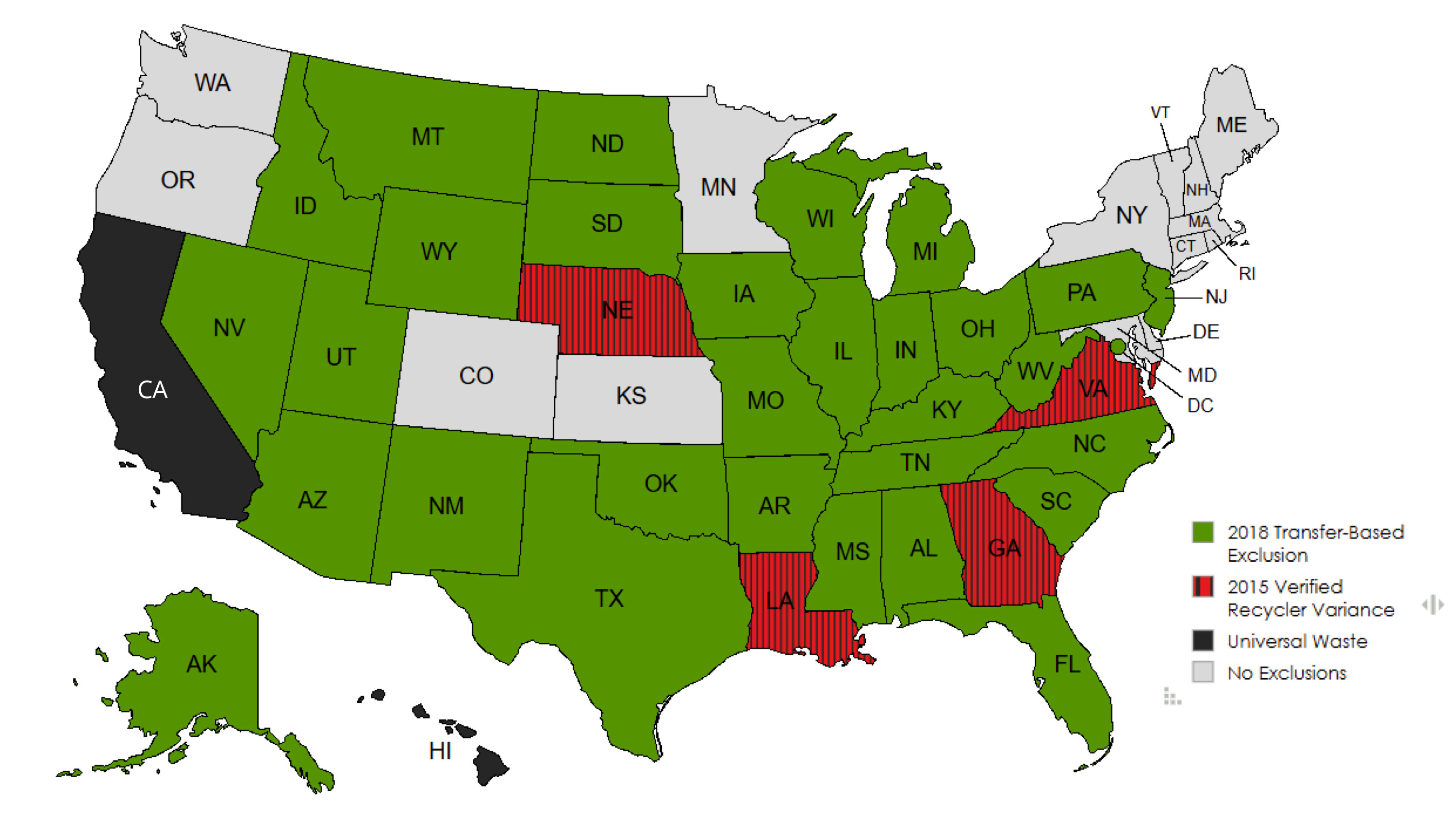
2015 Verified Recycler Exclusion |
States that adopted the 2015 Definition of Solid Waste (DSW) Rule, which included the Verified Recycler Exclusion at 40 CFR 261.4(a)(24). Source: EPA (updated June 30, 2025). |
|
2018 Transfer-Based Exclusion |
States that adopted or were authorized for the 2018 DSW Rule, which reinstated the Transfer-Based Exclusion following a 2017 D.C. Circuit Court decision vacating the 2015 Verified Recycler Exclusion. Alaska and Iowa follow federal rules administered by EPA. |
|
Solid Waste |
Solar panels managed as solid waste under state law with a passing TCLP test. |
|
Universal Waste |
California and Hawaii have adopted rules designating end-of-life solar panels as Universal Waste, enabling streamlined collection and recycling compared to full Subtitle C hazardous waste regulation. |
|
Hazardous Waste |
States that specifically regulate solar panels as hazardous waste under state RCRA-authorized programs. |
|
Hazardous Secondary Material (HSM) |
The EPA defines hazardous secondary material (HSM) means a secondary material (e.g., spent material, by-product, or sludge) that, when discarded, would be identified as hazardous waste under 40 CFR part 261. (40 CFR 260.10) |
|
Sources |
EPA – Where is the 2018 Definition of Solid Waste Rule in Effect? (epa.gov/hw/where-2018-definition-solid-waste-rule-effect) California: 22 CCR § 66273 (Universal Waste Rule for solar panels) Hawaii: HAR § 11-273 (Universal Waste Rule for solar panels) |
Connect with our team of regulatory and logistics specialists.